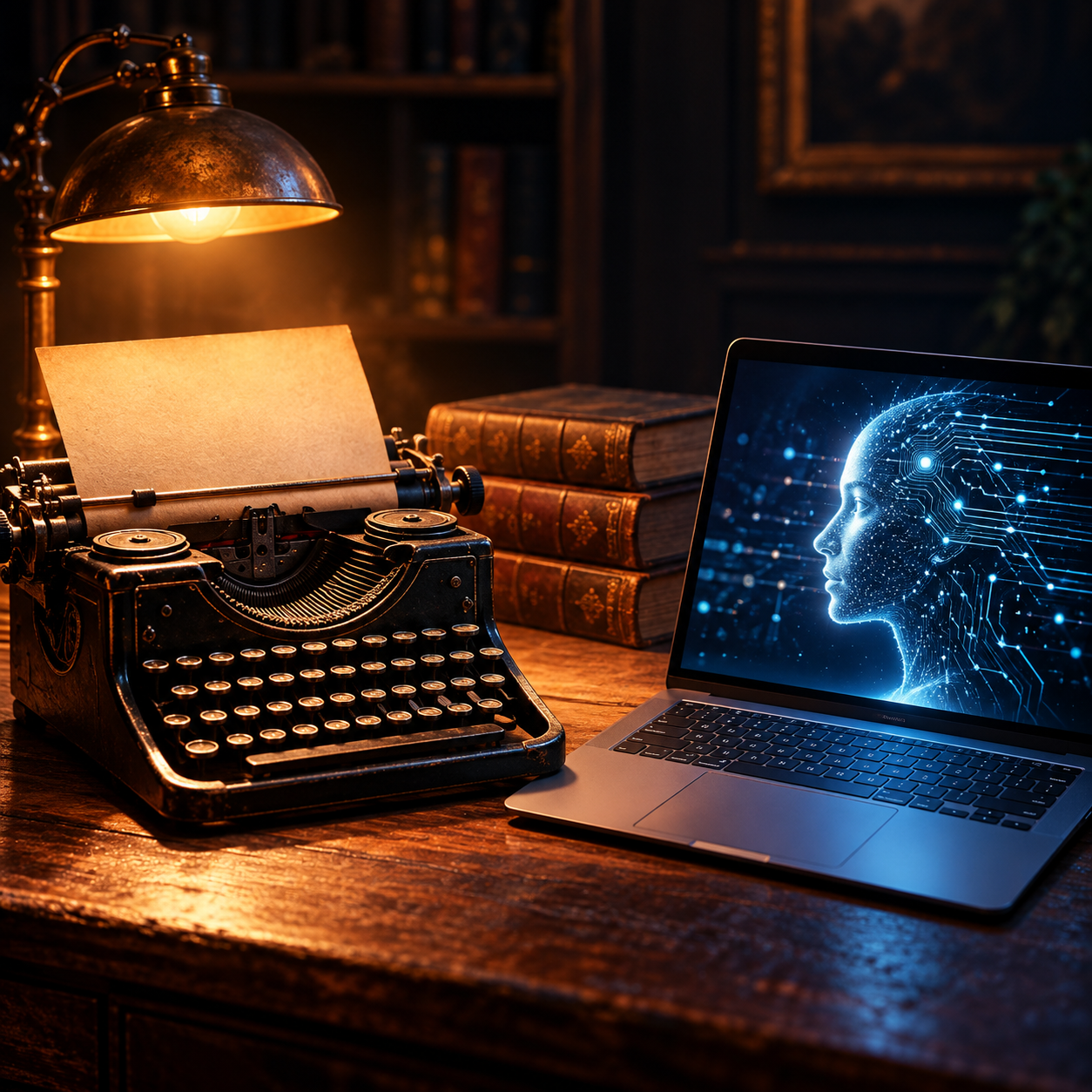
Talk about a sign of the times! My first-ever blog post as an indie author is about how I use and don’t use artificial intelligence in my author business. Yes, we live in the future.
But it’s an important topic to address, with the anti-AI police assuming any author who uses AI anywhere in their social media (especially if they use em-dashes) must also use AI to write their books.
I’m sorry, but that is so wrong and shortsighted. It’s also something I recently came up against with an event organizer who questioned my books based on a few images from social media that were created by AI (and appropriately tagged as such).
Rest assured, my books are not written by AI. And after a little back-and-forth with the organizer, my application was accepted. Still, I thought it was important to address how I use AI as an indie author.
Being an indie author is about a lot more than just writing books. I'm also responsible for sales, marketing, social media, newsletters, public relations, inventory management, event planning, accounting, and countless other tasks that have very little to do with storytelling. More tasks than any one person can (or should) be good at.
And while I wish I had the money to pay real people for each task, I don’t. I’m completely bootstrapping (or bookstrapping, if you prefer) this business by myself, with a family to support. I cannot afford to hire for all those positions, especially after paying a professional editor and cover designer to make my books as professional as possible.
This is where AI is helpful. It handles tasks I can’t manage on my own. Without it, you’d probably never have my books to read.
AI Doesn't Write My Books
Let's get the big question out of the way first—I do not use AI to write my novels.
Yes, I know I’ve said that already, but it bears repeating.
Every character, plot twist, conversation, and questionable decision made by the Miller family comes from my imagination. For better or worse, those are all mine.
Writing is the part of being an author I enjoy most. Why would I farm that out to a data center? I love the creative process—sitting down for a writing session with an idea of what I want my characters to do, only to have them completely surprise me.
I also enjoy the editing process—seeing what my manuscript was and what it became. And yes, I hire both a developmental editor and a line editor to assist with these functions, as most professional authors do.
Where I Do Use AI With My Books
I am terrible at coming up with titles for my books. If left to me, Blood Debt would have been titled What Daddy Did—which sounds more like erotica than a crime thriller. I usually ask ChatGPT to come up with 50 ideas. And then 50 more. Normally, I settle on something completely different. But it helps get the creative juices flowing.
I also sometimes use it to come up with character names—especially those that are inconsequential. Brady, Picasso, Mason, Jackson, Landis, and Claire? All my ideas. Some rando character who only appears on one page? I probably asked AI for ideas.
Some other ways I use AI with my books are research and fact-checking. Granted, I don’t allow it to think for me. I’ve had it create a few research reports for me, but they always missed the mark. Instead, I’ll have it find articles so I can read and interpret them myself.
The same goes for fact-checking. I have been known to ask it to fact-check something I've written, making sure it cites sources for my human eyes to verify. It’s just a quicker way to Google, I guess.
For especially tricky items that affect the plot, I use human subject matter experts. For Past Due, I had a pastor read the theological chapters. For book three, I interviewed a medic about how an ambulance ride works.
Finally, I’ll use AI to supplement the spelling and grammar checks from both Word and ProWritingAid.
How I Use AI to Run My Author Business
Now, this is where AI really earns its keep.
As I mentioned earlier, being an indie author means wearing more hats than I ever imagined. And while I have a background in sales, marketing, and journalism, there are still plenty of things I need help with.
One of my biggest uses for AI is marketing. I'll use it to brainstorm promotional ideas, help create a social media schedule, and occasionally create images. When I use AI-generated images, I label them accordingly. I'm not trying to fool anyone into thinking I hired a photographer or graphic designer.
I also use AI as a second set of eyes for newsletters, blog posts, and other communications. I'll write a draft, ask for proofreading or suggestions, and decide which changes to make. Sometimes the suggestions are helpful. Other times, ChatGPT decides to rewrite everything in its own voice, and we have a rather spirited disagreement. There's a reason I rely on AI for this, even as a writer. Not all writing is the same. A great copywriter isn't necessarily a great novelist, and vice versa.
Then there's the business side of things. I've used AI to help build and troubleshoot spreadsheets for tracking book inventory, analyze sales from author events, research potential marketing opportunities, and work through some of the financial decisions that come with running a small business.
As an independent author trying to build a business without a staff or an unlimited budget, I see nothing wrong with using the tools available to me. I still do the writing, and I still do the decision making.
And if using ChatGPT to help manage my inventory or create the occasional Instagram image makes me less of an author in someone's eyes, so be it. They’re probably not my readers, anyway. I'll keep writing my books with my own imagination, my own words, and yes, the occasional em-dash.
P.S. - And yes, AI was used to create the image for this blog post. Sorry, not sorry.
